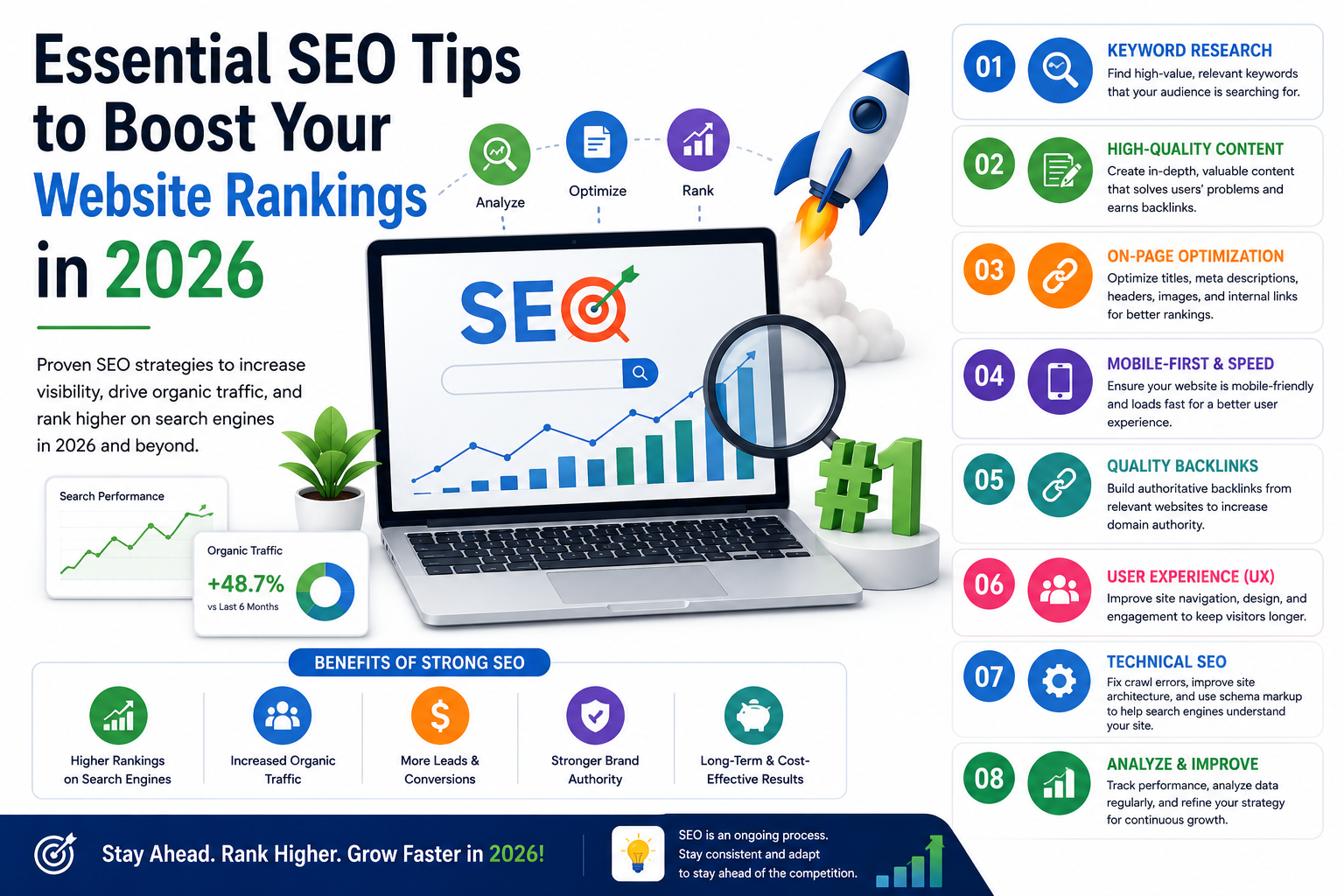
Search Engine Optimization (SEO) continues to be one of the most effective ways to increase website traffic and improve online visibility. In 2026, competition on search engines is higher than ever, making SEO more important for bloggers, businesses, and website owners.
Whether you run a personal blog, an online store, or a business website, implementing the right SEO strategies can help you achieve higher rankings on Google and attract more organic traffic.
This guide covers the essential SEO tips you need to boost your website rankings in 2026.
What Is SEO?
SEO stands for Search Engine Optimization. It is the process of improving your website to rank higher in search engine results pages (SERPs).
The main goal of SEO is to:
- Increase organic traffic
- Improve online visibility
- Attract targeted visitors
- Generate leads and sales
A strong SEO strategy helps your website grow naturally without relying entirely on paid advertising.
Why SEO Is Important in 2026
SEO remains important because most online experiences begin with a search engine.
Benefits of SEO include:
- More website visitors
- Better brand awareness
- Increased credibility
- Higher conversion rates
- Long-term business growth
Unlike paid advertising, SEO can continue delivering traffic for months or even years.
1. Perform Proper Keyword Research
Keyword research is the foundation of every successful SEO strategy.
Keywords are the words and phrases users type into search engines.
How to Find Good Keywords
Look for keywords that have:
- Good search volume
- Low or medium competition
- Clear user intent
Useful Keyword Research Tools
- Google Keyword Planner
- Ubersuggest
- Ahrefs
- SEMrush
Long-tail keywords often perform better because they target specific user searches.
Example:
Instead of targeting “SEO”, target “essential SEO tips for beginners”.
2. Understand Search Intent
Search intent refers to the reason behind a user’s search.
There are four main types of search intent:
Informational Intent
Users want information.
Example:
“How does SEO work?”
Navigational Intent
Users want to visit a specific website.
Example:
“Google Search Console”
Commercial Intent
Users are comparing products or services.
Example:
“Best SEO tools”
Transactional Intent
Users are ready to buy.
Example:
“Buy SEO course”
Creating content that matches search intent increases ranking opportunities.
3. Optimize Title Tags
Your title tag is one of the most important ranking factors.
Tips for writing effective titles:
- Include your focus keyword
- Keep it under 60 characters
- Make it attractive and clickable
Example:
Essential SEO Tips to Boost Your Website Rankings in 2026
Well-optimized titles improve click-through rates.
4. Write Compelling Meta Descriptions
Meta descriptions encourage users to click on your search result.
Best practices:
- Include the target keyword
- Keep it under 160 characters
- Clearly explain the page content
A strong meta description can increase organic traffic.
5. Create High-Quality Content
Content remains the most important element of SEO.
Google prioritizes content that is:
- Helpful
- Original
- Accurate
- Comprehensive
Your content should answer user questions and provide real value.
Always focus on helping readers instead of writing only for search engines.
6. Use Proper Heading Structure
Headings organize content and improve readability.
Use:
- H1 for the main title
- H2 for major sections
- H3 for subtopics
Headings help search engines understand your content structure.
7. Optimize for Mobile Devices
Most users access websites through smartphones.
Google uses mobile-first indexing, meaning it primarily evaluates the mobile version of your website.
Your website should:
- Be mobile-friendly
- Load quickly
- Display correctly on all devices
Mobile optimization improves both rankings and user experience.
8. Improve Website Speed
Page speed is an important ranking factor.
Slow websites increase bounce rates and reduce conversions.
Ways to improve website speed:
- Compress images
- Use fast web hosting
- Enable browser caching
- Remove unnecessary plugins
Fast websites usually rank better and provide a better user experience.
9. Optimize Images for SEO
Images can help improve rankings when optimized properly.
Image SEO tips:
- Use descriptive file names
- Compress images
- Add alt text
- Choose appropriate image sizes
Example alt text:
“essential SEO tips infographic”
Optimized images also improve website speed.
10. Use Internal Linking
Internal links connect pages within your website.
Benefits include:
- Better navigation
- Improved indexing
- Increased page authority
- More page views
Always link related articles naturally.
For example, an SEO article can link to blogging or digital marketing guides.
11. Build High-Quality Backlinks
Backlinks are links from other websites pointing to your content.
Google considers backlinks as votes of confidence.
Effective backlink strategies include:
- Guest posting
- Creating valuable content
- Outreach campaigns
- Broken link building
Focus on quality rather than quantity.
A few high-authority backlinks are better than hundreds of low-quality links.
12. Publish Content Consistently
Consistency is essential for SEO success.
Regular publishing helps:
- Increase indexed pages
- Build authority
- Improve rankings
Create a content calendar and maintain a consistent schedule.
Even publishing one or two high-quality articles weekly can produce excellent results.
13. Update Old Content
SEO is not a one-time process.
Older articles may lose rankings over time.
Update content regularly by:
- Adding fresh information
- Updating statistics
- Improving SEO optimization
- Fixing broken links
Content updates often improve rankings significantly.
14. Focus on User Experience (UX)
User experience directly affects SEO performance.
Google wants to rank websites that provide a positive experience.
Improve UX by:
- Using clean design
- Improving readability
- Simplifying navigation
- Reducing intrusive advertisements
Good user experience encourages visitors to stay longer.
15. Use Structured Data
Structured data helps search engines understand your content better.
Benefits include:
- Rich snippets
- Better visibility
- Higher click-through rates
Examples of schema markup:
- Article schema
- FAQ schema
- Review schema
Structured data can make your search listings more attractive.
16. Secure Your Website With HTTPS
Website security is a ranking factor.
Use an SSL certificate to enable HTTPS.
Benefits include:
- Better security
- Improved trust
- Potential ranking improvements
Most hosting companies provide free SSL certificates.
17. Optimize for Voice Search
Voice search continues growing in 2026.
People often use conversational queries such as:
“How can I improve my website SEO?”
Optimize for voice search by:
- Answering questions directly
- Using conversational language
- Targeting long-tail keywords
Voice search optimization can provide additional traffic opportunities.
18. Monitor SEO Performance
Tracking results helps identify strengths and weaknesses.
Essential SEO tools include:
Google Search Console
Monitors search performance.
Google Analytics
Tracks traffic and user behavior.
Ahrefs
Analyzes backlinks and keywords.
SEMrush
Provides comprehensive SEO insights.
Regular monitoring helps improve strategy.
Common SEO Mistakes to Avoid
Avoid these common mistakes:
- Keyword stuffing
- Duplicate content
- Slow website speed
- Poor mobile optimization
- Ignoring search intent
- Buying spam backlinks
Avoiding these mistakes improves rankings and user experience.
How Long Does SEO Take?
SEO requires patience.
Typical timelines:
- Initial improvements: 1–3 months
- Significant growth: 3–6 months
- Competitive niches: 6–12 months
Consistent effort produces long-term results.
Future SEO Trends in 2026
SEO continues evolving.
Important trends include:
- Artificial Intelligence
- Voice search
- User experience optimization
- Video SEO
- E-E-A-T principles
Staying updated with trends helps maintain rankings.
Conclusion
SEO remains one of the most effective ways to grow a website in 2026. By implementing essential SEO tips such as keyword research, content optimization, mobile friendliness, backlink building, and user experience improvements, you can significantly boost your website rankings.
Remember that SEO is a long-term process. Stay consistent, continue learning, and focus on providing value to users. Over time, these efforts will help you achieve higher rankings and sustainable organic traffic.
SEO Guide for Beginners: Step-by-Step SEO Learning
Google Search Console