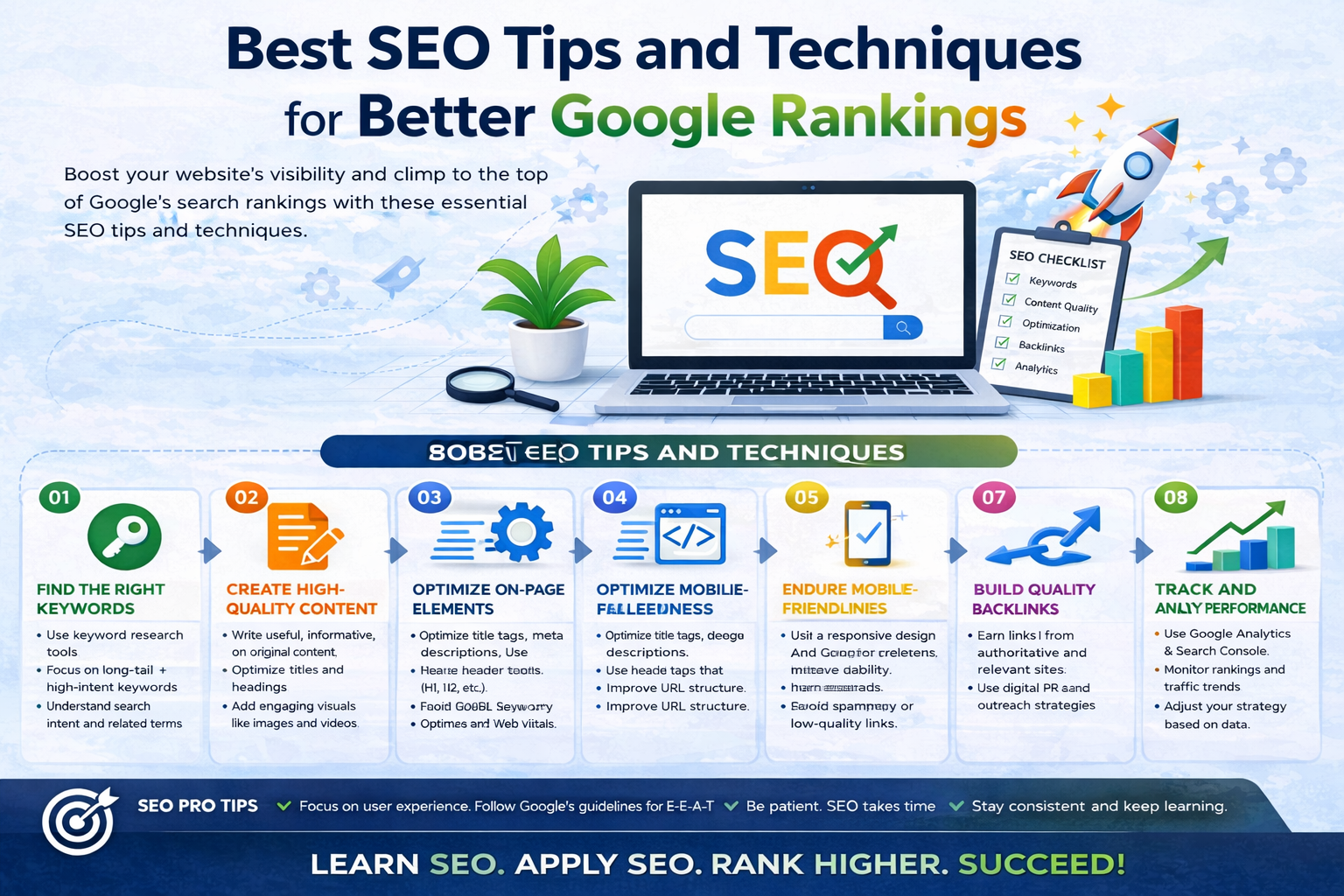
Search Engine Optimization (SEO) is one of the most important digital marketing strategies for website owners, bloggers, and businesses. Every day, millions of people use Google to search for information, products, and services. If your website ranks higher in search results, you can attract more visitors, generate leads, and grow your online presence.
Google constantly updates its algorithms to provide users with the best possible search experience. Because of these updates, website owners must follow modern SEO techniques to maintain and improve their rankings. Understanding the best SEO tips can help your website stay competitive and achieve long-term success.
This guide explains the most effective SEO tips and techniques that can help improve Google rankings and increase organic traffic.
What Is SEO?
SEO stands for Search Engine Optimization. It is the process of improving a website to rank higher on search engines such as Google.
The primary goal of SEO is to increase organic traffic. Organic traffic comes from search engine results without paying for advertisements.
SEO involves:
- Keyword research
- Content optimization
- Website improvements
- Link building
- Technical optimization
When these elements work together, websites can achieve better rankings and attract more visitors.
Why Google Rankings Matter
Most internet users click on results appearing on the first page of Google.
Higher rankings provide:
- More website traffic
- Better visibility
- Increased credibility
- More leads
- Higher sales
Websites appearing on the second or third page often receive very little traffic compared to first-page results.
This makes SEO essential for online success.
1. Focus on High-Quality Content
Content remains the foundation of successful SEO.
Google wants to rank content that provides value to users.
Good content should:
- Answer questions
- Solve problems
- Be easy to understand
- Provide accurate information
- Offer practical solutions
High-quality content encourages visitors to stay longer on your website and improves rankings.
2. Perform Effective Keyword Research
Keyword research helps identify what people are searching for online.
Popular keyword research tools include:
- Google Keyword Planner
- Ahrefs
- SEMrush
- Ubersuggest
Choose keywords that:
- Match user intent
- Have good search volume
- Are relevant to your topic
- Have manageable competition
Proper keyword research forms the foundation of every successful SEO strategy.
3. Use Keywords Naturally
Keywords help search engines understand your content.
However, keywords should be used naturally throughout the article.
Important places for keywords include:
- SEO title
- Introduction
- Headings
- Meta description
- Conclusion
Avoid keyword stuffing because it can negatively affect rankings.
4. Write SEO-Friendly Titles
The title is one of the first things users notice in search results.
A strong SEO title should:
- Include the focus keyword
- Be clear and attractive
- Encourage clicks
- Stay under 60 characters
Well-written titles improve click-through rates and search visibility.
5. Optimize Meta Descriptions
Meta descriptions summarize page content.
A good meta description should:
- Include the focus keyword
- Explain the content clearly
- Encourage users to click
Although meta descriptions are not direct ranking factors, they help increase clicks from search results.
6. Use Proper Heading Structure
Headings organize content and improve readability.
Use:
- H1 for the main title
- H2 for major sections
- H3 for sub-sections
Proper heading structure helps both users and search engines understand your content.
7. Improve Website Speed
Website speed is a major ranking factor.
Slow websites often experience:
- Higher bounce rates
- Lower engagement
- Reduced conversions
Ways to improve speed:
- Compress images
- Use quality hosting
- Enable caching
- Minimize unnecessary plugins
Fast websites provide a better user experience and rank higher.
8. Optimize for Mobile Devices
Most internet users browse websites on smartphones.
A mobile-friendly website should:
- Load quickly
- Display properly
- Be easy to navigate
Google uses mobile-first indexing, making mobile optimization essential for SEO success.
9. Create Valuable Content Regularly
Publishing content consistently helps improve website authority.
Content ideas include:
- Tutorials
- Guides
- Case studies
- Industry news
- Frequently asked questions
Regular updates signal to search engines that your website remains active and relevant.
10. Build High-Quality Backlinks
Backlinks are links from other websites pointing to your website.
Google views backlinks as votes of confidence.
Benefits include:
- Improved authority
- Higher rankings
- Increased traffic
Ways to earn backlinks:
- Guest posting
- Creating useful resources
- Publishing original research
- Building relationships with website owners
Focus on quality rather than quantity.
11. Strengthen Internal Linking
Internal links connect pages within your website.
Benefits include:
- Better navigation
- Improved indexing
- Increased page views
- Better user experience
Link related articles to help visitors discover more content.
12. Optimize Images
Images improve engagement but should be optimized properly.
Best practices include:
- Compress image sizes
- Use descriptive file names
- Add alt text
- Use relevant images
Optimized images improve both page speed and accessibility.
13. Improve User Experience
User experience is becoming increasingly important for SEO.
Factors that improve user experience include:
- Fast loading speed
- Clean design
- Easy navigation
- Helpful content
Websites that provide positive experiences often achieve better rankings.
14. Focus on Search Intent
Search intent refers to what users want when they search.
Common search intents include:
- Informational
- Commercial
- Transactional
- Navigational
Content should match the user’s intent to achieve better rankings.
15. Optimize for Voice Search
Voice search continues to grow in popularity.
People use natural language when speaking to voice assistants.
Voice search optimization tips:
- Use conversational keywords
- Create FAQ sections
- Answer questions directly
- Focus on local SEO
Voice search can bring additional traffic to your website.
16. Update Old Content
Updating existing content can improve rankings.
Update:
- Statistics
- Examples
- Links
- Images
- Information
Fresh content often performs better in search results.
17. Use Structured Data
Structured data helps search engines understand content better.
Benefits include:
- Rich snippets
- Better visibility
- Higher click-through rates
Schema markup can improve how pages appear in search results.
18. Monitor SEO Performance
SEO requires regular monitoring.
Track important metrics such as:
- Organic traffic
- Keyword rankings
- Bounce rates
- Click-through rates
- Conversion rates
Monitoring performance helps identify opportunities for improvement.
19. Use SEO Tools
Several tools can simplify SEO tasks.
Popular SEO tools include:
Google Search Console
Helps monitor search performance.
Google Analytics
Tracks visitor behavior and traffic sources.
Ahrefs
Provides backlink and keyword analysis.
SEMrush
Offers comprehensive SEO insights.
Ubersuggest
Provides keyword ideas and competitor analysis.
These tools help website owners make data-driven decisions.
20. Focus on Local SEO
Local SEO is important for businesses serving specific locations.
Strategies include:
- Optimizing Google Business Profile
- Using local keywords
- Collecting customer reviews
- Creating local content
Local SEO helps attract nearby customers.
Common SEO Mistakes to Avoid
Many beginners make mistakes that hurt rankings.
Keyword Stuffing
Use keywords naturally.
Duplicate Content
Always create original content.
Ignoring Mobile Users
Mobile optimization is essential.
Poor Internal Linking
Connect related pages effectively.
Slow Website Speed
Optimize performance regularly.
Low-Quality Backlinks
Avoid spammy link-building techniques.
Benefits of SEO
Effective SEO offers many benefits.
Increased Traffic
Higher rankings attract more visitors.
Better Brand Awareness
More people discover your website.
Higher Conversions
Targeted traffic improves conversion rates.
Long-Term Results
SEO continues generating traffic over time.
Lower Marketing Costs
Organic traffic reduces dependence on paid advertising.
Future of SEO
SEO continues to evolve rapidly.
Important trends include:
- Artificial Intelligence
- Voice Search
- Mobile-First Indexing
- User Experience Signals
- Helpful Content Updates
Businesses that adapt to these trends will remain competitive.
Conclusion
Following the best SEO tips and techniques can significantly improve Google rankings and increase website traffic. High-quality content, keyword research, website speed, mobile optimization, backlinks, internal linking, and user experience all contribute to SEO success SEO tips.
SEO is a long-term strategy that requires patience and consistency. tips By applying these proven techniques and staying updated with industry changes, website owners can achieve better rankings, attract more visitors, and build a stronger online presence.
SEO Guide for Beginners: Step-by-Step SEO Learning
Google Search Console