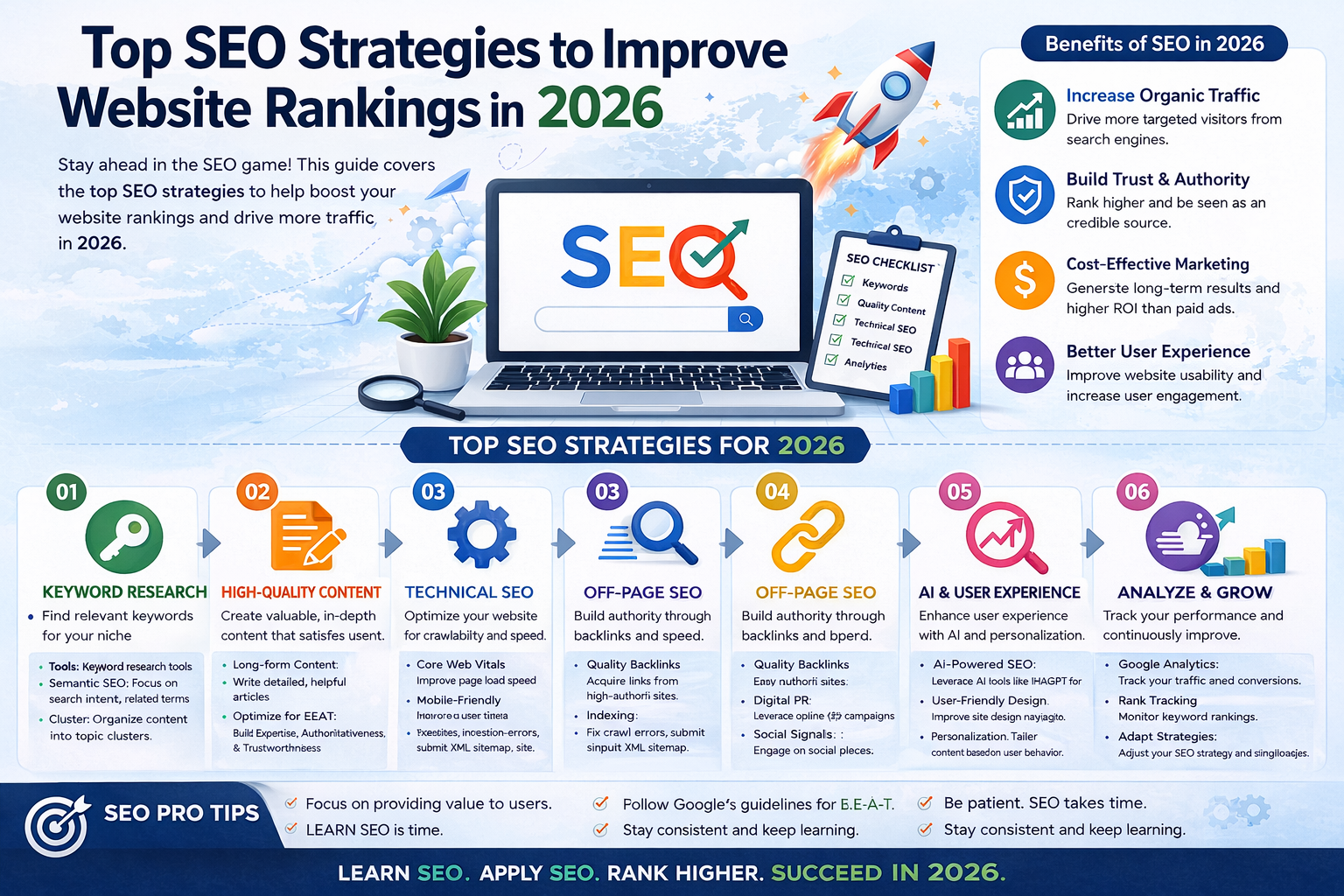
Search Engine Optimization (SEO) continues to be one of the most effective digital marketing methods for increasing website traffic and improving online visibility. As search engines become smarter and user expectations continue to rise, website owners must adapt their SEO strategies to stay competitive.
In 2026, SEO is no longer just about adding keywords to content. Search engines now focus on user experience, content quality, website performance, and relevance. Businesses, bloggers, and website owners who follow modern SEO practices can achieve higher rankings and attract more visitors SEO strategies.
This guide explains the top SEO strategies that can help improve website rankings in 2026.
Why SEO Is Important in 2026
Millions of websites compete for attention on search engines every day. Most users click results that appear on the first page of Google.
SEO helps businesses:
- Increase organic traffic
- Improve online visibility
- Build brand authority
- Generate leads
- Increase sales
- Improve user experience
A strong SEO strategy helps websites remain competitive in an increasingly crowded online environment.
1. Focus on High-Quality Content
Content remains one of the most important ranking factors.
Google wants to provide users with valuable, accurate, and helpful information. Websites that consistently publish high-quality content are more likely to rank well.
Good content should:
- Answer user questions
- Solve problems
- Be easy to read
- Provide accurate information
- Be regularly updated
Creating valuable content helps attract visitors and encourages them to stay longer on your website.
2. Perform Smart Keyword Research
Keyword research remains the foundation of successful SEO.
Keywords help search engines understand what your content is about.
Popular keyword research tools include:
- Google Keyword Planner
- Ahrefs
- SEMrush
- Ubersuggest
Focus on:
- Long-tail keywords
- Low-competition keywords
- User intent
- Relevant search terms
Using the right keywords helps your content reach the correct audience.
3. Optimize Search Intent
Search intent refers to the reason behind a user’s search query.
Users may be looking for:
- Information
- Products
- Services
- Comparisons
- Solutions
Understanding search intent allows you to create content that matches user expectations.
When content satisfies search intent, rankings often improve.
4. Improve Website Speed
Website speed is a major ranking factor.
Users expect websites to load quickly. Slow websites often experience higher bounce rates and lower conversions.
Ways to improve speed include:
- Compress images
- Use fast hosting
- Enable caching
- Minimize code
- Reduce unnecessary plugins
Fast-loading websites provide a better user experience and improve SEO performance.
5. Prioritize Mobile Optimization
Most internet users browse websites using smartphones.
Google uses mobile-first indexing, meaning it primarily evaluates the mobile version of a website.
A mobile-friendly website should:
- Load quickly
- Display correctly
- Have simple navigation
- Be easy to use
Mobile optimization improves both rankings and user satisfaction.
6. Use SEO-Friendly URLs
Clean URLs help users and search engines understand page content.
Example:
Good URL:yourwebsite.com/top-seo-strategies-2026
Poor URL:yourwebsite.com/page?id=12345
SEO-friendly URLs improve readability and click-through rates.
7. Optimize Title Tags
Title tags are one of the most important on-page SEO elements.
A good title should:
- Include the focus keyword
- Be clear and attractive
- Stay under 60 characters
Well-optimized titles improve search visibility and increase clicks.
8. Write Effective Meta Descriptions
Meta descriptions summarize page content.
A strong meta description should:
- Include keywords naturally
- Explain the content clearly
- Encourage clicks
Although meta descriptions are not a direct ranking factor, they improve click-through rates.
9. Use Proper Heading Structure
Headings organize content and improve readability.
Use:
- H1 for the main title
- H2 for major sections
- H3 for sub-sections
Proper heading structure helps search engines understand content better.
10. Optimize Images for SEO
Images improve user experience but should be optimized properly.
Best practices include:
- Compress image sizes
- Use descriptive file names
- Add alt text
- Choose relevant images
Optimized images improve page speed and accessibility.
11. Build High-Quality Backlinks
Backlinks remain one of the strongest ranking signals.
A backlink is a link from another website pointing to your site.
Quality backlinks:
- Increase authority
- Improve trust
- Boost rankings
Ways to earn backlinks:
- Guest posting
- Creating valuable content
- Building relationships
- Publishing research and guides
Focus on quality rather than quantity.
12. Strengthen Internal Linking
Internal links connect pages within your website.
Benefits include:
- Better navigation
- Improved SEO
- Increased page views
- Better indexing
Link related articles together to help visitors discover more content.
13. Improve User Experience (UX)
Google values websites that provide a positive user experience.
Important UX factors include:
- Easy navigation
- Fast loading speed
- Mobile responsiveness
- Clear design
- Useful content
Better user experience often leads to higher rankings and engagement.
14. Optimize for Voice Search
Voice search continues to grow in popularity.
People use voice assistants to search for information using natural language.
Voice search optimization tips:
- Use conversational keywords
- Answer common questions
- Create FAQ sections
- Focus on local SEO
Voice search can help attract additional traffic.
15. Target Featured Snippets
Featured snippets appear above regular search results.
They provide quick answers to user questions.
To increase your chances:
- Answer questions clearly
- Use bullet points
- Include numbered lists
- Create concise explanations
Featured snippets can significantly increase visibility and clicks.
16. Focus on Local SEO
Local SEO is important for businesses serving specific locations.
Local SEO strategies include:
- Optimizing Google Business Profile
- Collecting customer reviews
- Using local keywords
- Creating location-based content
Strong local SEO helps businesses attract nearby customers.
17. Update Old Content
Updating existing content can improve rankings.
Review older articles and:
- Add new information
- Improve readability
- Update statistics
- Fix broken links
- Optimize keywords
Fresh content often performs better in search results.
18. Use Structured Data
Structured data helps search engines understand website content.
Benefits include:
- Rich search results
- Improved visibility
- Better click-through rates
Schema markup can provide additional information directly in search results.
19. Monitor SEO Performance
Tracking performance helps identify strengths and weaknesses.
Monitor:
- Organic traffic
- Keyword rankings
- Bounce rates
- Click-through rates
- Conversion rates
Regular analysis allows for continuous improvement.
20. Use SEO Tools Effectively
SEO tools provide valuable insights.
Popular tools include:
- Google Search Console
- Google Analytics
- Ahrefs
- SEMrush
- Ubersuggest
These tools help website owners monitor progress and make better decisions.
Common SEO Mistakes to Avoid
Many website owners make mistakes that hurt rankings.
Avoid:
Keyword Stuffing
Use keywords naturally rather than excessively.
Duplicate Content
Always publish original content.
Ignoring Mobile Users
Mobile optimization is essential in 2026.
Slow Website Speed
Fast websites perform better.
Poor Internal Linking
Connect related pages effectively.
Low-Quality Backlinks
Focus on earning links from trusted websites.
Benefits of Strong SEO
Effective SEO provides long-term advantages.
More Organic Traffic
Higher rankings attract more visitors.
Better Brand Visibility
More users discover your content.
Increased Trust
Top-ranking websites often appear more credible.
Higher Conversions
Targeted traffic leads to better results.
Sustainable Growth
SEO continues generating traffic over time.
Future of SEO
SEO continues to evolve as search engines become smarter.
Important trends for 2026 include:
- Artificial Intelligence
- Voice Search
- Mobile-First Indexing
- User Experience Signals
- Helpful Content Updates
Websites that adapt to these trends will have a better chance of maintaining strong rankings.
Conclusion
The top SEO strategies for 2026 focus on providing value to users while improving website performance. High-quality content, keyword research, mobile optimization, website speed, backlinks, internal linking, and user experience all play important roles in SEO success.
By implementing these strategies consistently, website owners can improve rankings, increase organic traffic, and achieve long-term online growth. SEO requires patience and ongoing effort, but the rewards can be significant for businesses and bloggers alike.
SEO Guide for Beginners: Step-by-Step SEO Learning
Google Search Console